

Ever wondered why some slot games give you small wins constantly, while others make you wait forever before hitting something big? The answer is volatility—and understanding it could save you hundreds of dollars.
Picture this: you’re playing two different slot games, both with a 96% return rate. But they feel completely different. One keeps your balance steady with frequent little wins. The other drains your money for 100 spins, then suddenly drops a 500x payout that changes everything.
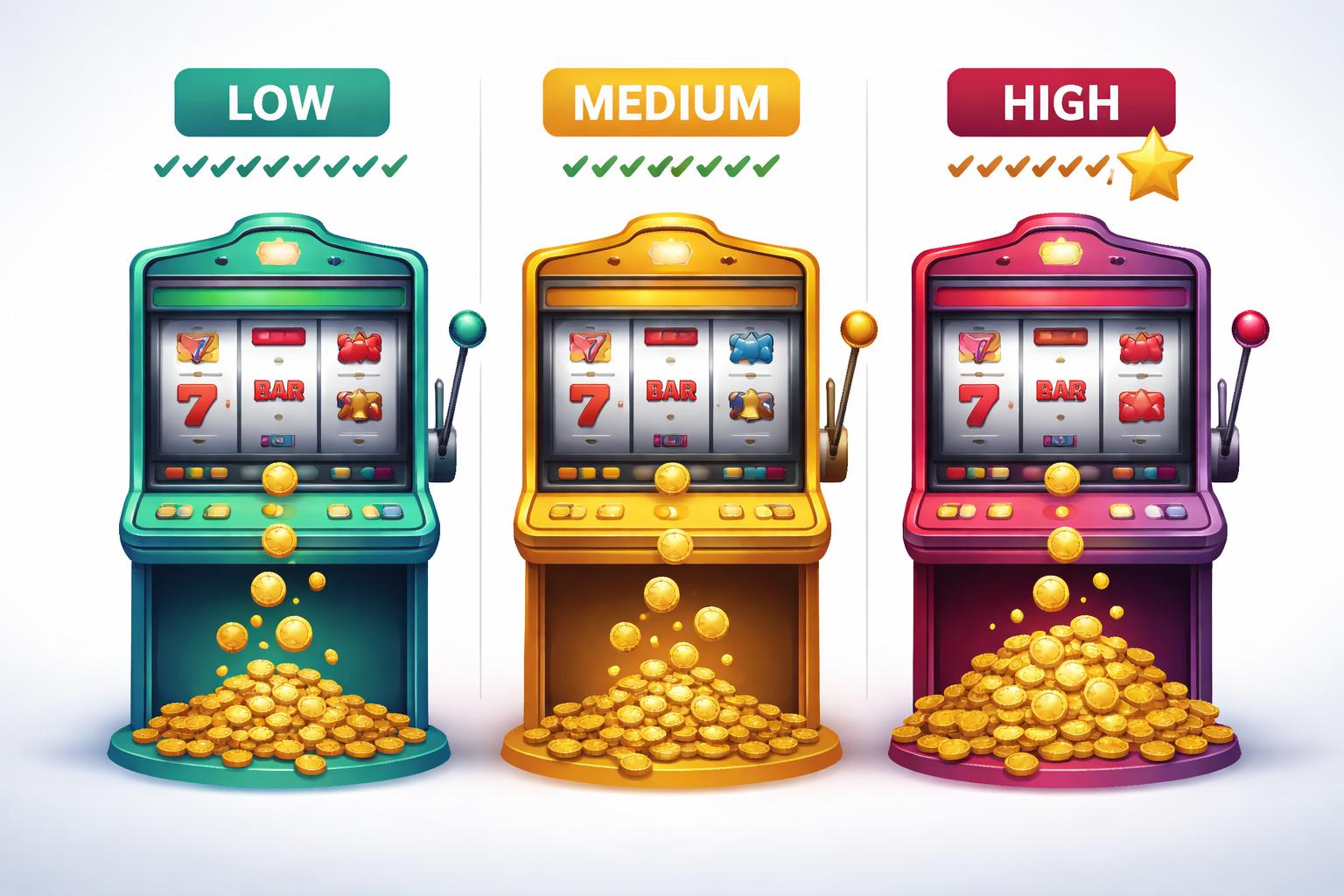
Here’s what casinos don’t tell you: volatility matters MORE than RTP for your actual playing experience. Let’s break down exactly what this means for your bankroll.
What Is Slot Volatility? (In Plain English)
Slot volatility (also called variance) is basically the risk level of a slot game. It tells you two critical things:
- How often you’ll win (hit frequency)
- How much you’ll typically win when you do (payout size)
Think of it as the game’s personality. Low volatility slots are like that reliable friend who always shows up—they give you lots of small wins to keep things interesting. High volatility slots are the wild card—long stretches of nothing, then boom, a massive payout that could change your night (or more likely, you go broke first).
How Game Developers Create Volatility
Behind every slot is complex math. Developers use probability calculations to design how volatile a game will be:
- Symbol distribution: How symbols are spread across the reels determines how often you win
- Paytable structure: The ratio between small wins and big wins
- Bonus features: Special features add extra layers of unpredictability
- Maximum win potential: The biggest possible payout sets the upper limit of risk
A slot with lots of medium-paying symbols and frequent bonuses? That’s low volatility by design. A game with rare symbols that unlock massive multipliers? High volatility all the way.
Just like how RNG determines each spin’s outcome, volatility shapes the overall experience through mathematical modeling.
The Real Money Impact: What Volatility Means for YOUR Bankroll
Here’s the table every slot player needs to see BEFORE depositing:
| Volatility Level | $100 Bankroll Expected Playtime | Chance of Doubling Your Money | Chance of Busting in 30 Minutes | Best For | Bet Size Strategy |
|---|---|---|---|---|---|
| Low | 60-90 minutes | 5% | 10% | Casual fun, bonus clearing, extended play | 1-2% per spin ($1-2) |
| Low-Medium | 45-75 minutes | 12% | 20% | Balanced entertainment | 1-1.5% per spin ($1-1.50) |
| Medium | 30-60 minutes | 18% | 35% | Most players, good balance | 0.5-1% per spin ($0.50-1) |
| Medium-High | 20-45 minutes | 25% | 50% | Thrill-seekers, bonus hunters | 0.5% per spin ($0.50) |
| High | 10-30 minutes | 35% | 70% | Big win hunters, streamers | 0.25-0.5% per spin ($0.25-0.50) |
The brutal truth: If you have $100 and pick a high volatility slot, there’s a 70% chance you’ll be broke in under 30 minutes. With low volatility, you have a 90% chance of playing for a full hour.
Spot Volatility Instantly: The Red Flags
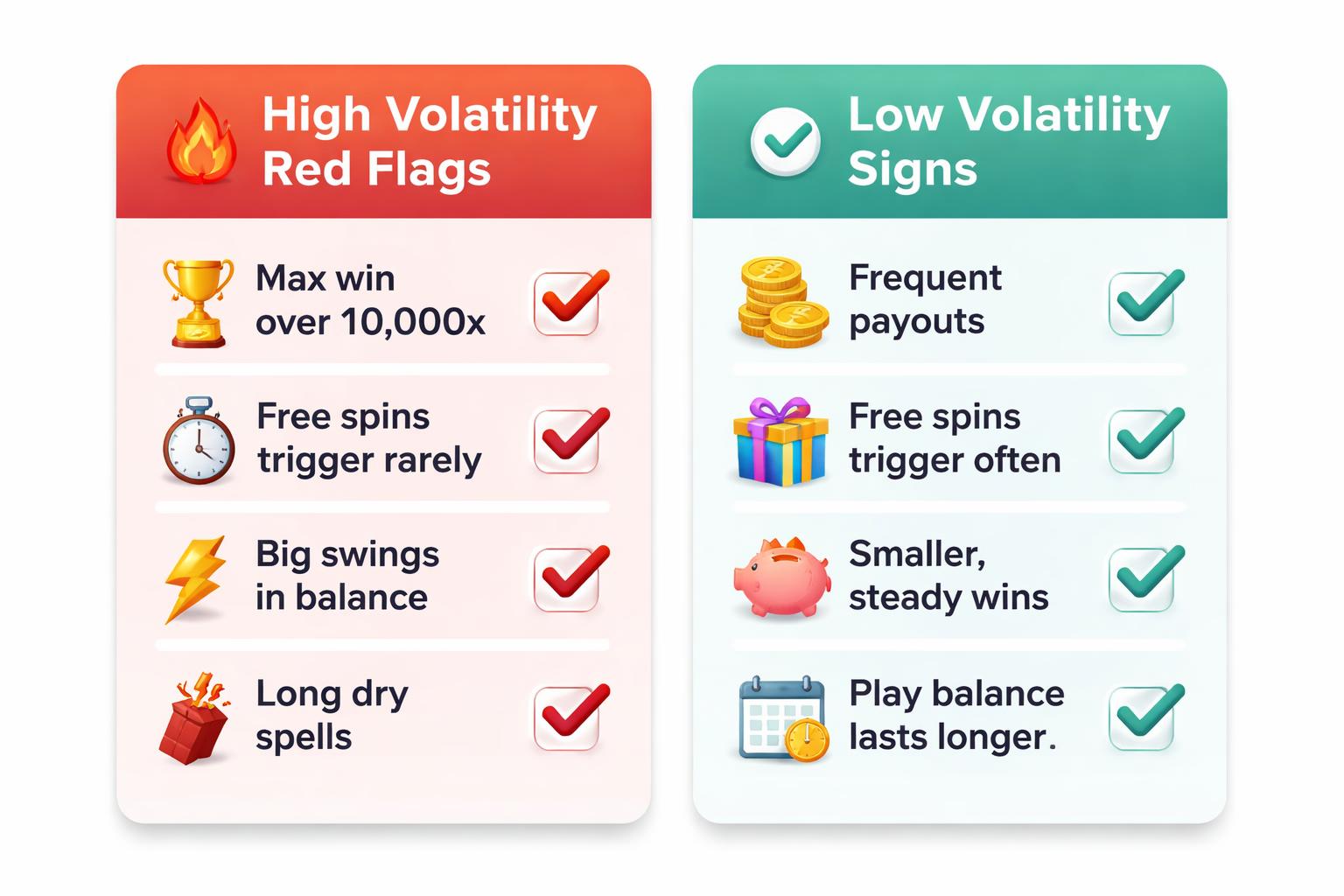
Don’t rely on casino descriptions. You can spot high volatility games by looking for max wins over 10,000x your bet, free spins that trigger rarely (100+ spins between features), and huge multipliers in bonus rounds. If you’re seeing lots of dead spins with no wins for 10+ consecutive spins, you’re in high volatility territory.
Low volatility games are easier to identify because they pay something on almost half your spins. The max win is usually under 1,000x, and you’ll notice your balance moves slowly up and down rather than swinging wildly. Medium volatility sits in between with max wins around 2,500x to 7,500x and bonuses triggering every 80-120 spins.
The Five Levels Explained (With Real Examples)

Low Volatility
Stats:
- Win frequency: 40-60% of spins pay out
- Typical wins: 0.5x to 5x your bet
- Maximum win: Usually under 1,000x your bet
Real Example: Starburst (NetEnt)
This game hits every 2-3 spins with a 96.09% RTP and 500x max win. If you deposit $100, expect 60-90 minutes of playtime. Your balance hovers between $80-$120 most of the time. You rarely get huge wins, but you rarely go broke fast either.
It’s predictable, safe, boring for some, perfect for others. This is your go-to for clearing bonus wagering requirements or just having a relaxing session without the stress of watching your bankroll disappear.
Low-Medium Volatility
Stats:
- Win frequency: 35-50% of spins
- Typical wins: 1x to 10x your bet
- Maximum win: 1,000x to 2,500x your bet
Real Example: Twin Spin (NetEnt)
With 96.55% RTP, this game hits every 3-4 spins with a 1,000x max win. The experience is more exciting than low volatility because you’ll get some 20x-50x wins that feel genuinely good, but your bankroll won’t swing wildly enough to cause anxiety. This works perfectly for players who want occasional excitement with decent playtime—essentially the “best of both worlds” approach.
Medium Volatility
Stats:
- Win frequency: 25-35% of spins
- Typical wins: 2x to 20x your bet
- Maximum win: 2,500x to 7,500x your bet
Real Example: Book of Dead (Play’n GO)
This is where most successful slots live, and for good reason. At 96.21% RTP, it hits every 4 spins with a 5,000x max win. You get enough wins to stay engaged, with occasional bonus rounds that can deliver 100x-500x payouts. Your $100 lasts 30-60 minutes with moderate betting.
Casino operators absolutely love this volatility level because it produces the highest overall profitability per game—it balances player satisfaction with house edge perfectly. Players feel like they’re winning without the casino losing money.
Medium-High Volatility
Stats:
- Win frequency: 20-30% of spins
- Typical wins: 5x to 50x your bet
- Maximum win: 7,500x to 20,000x your bet
Real Example: Dead or Alive 2 (NetEnt)
With 96.80% RTP and hitting every 5-6 spins, this game delivers a max win of 11,154x. Expect long dry spells followed by bonuses that can pay 200x-1,000x. Your $100 might last 20-45 minutes, or you might hit early and play for hours. High variance means high emotional swings.
This isn’t for casual players or small bankrolls—you need to genuinely understand and accept that you’ll probably lose your deposit, but if the stars align, you could walk away with a memorable win.
High Volatility
Stats:
- Win frequency: 15-25% of spins
- Typical wins: 10x to 100x your bet (when they hit)
- Maximum win: 20,000x to 150,000x your bet
Real Example: Money Train 2 (Relax Gaming)
This extreme game offers 96.40%-98% RTP (depending on settings) and hits roughly every 6-7 spins with a staggering 50,000x max win.
Let’s be brutally honest here—70% of players go broke in under 30 minutes. Most sessions are exercises in frustration. You’ll watch your balance evaporate spin after spin. But when the bonus finally hits, it can genuinely be life-changing.
These games are designed to create viral streaming moments, not consistent entertainment. Only play with money you can afford to lose completely, and understand you’re essentially buying lottery tickets, not playing a balanced game.
Before You Play: The Decision Tree
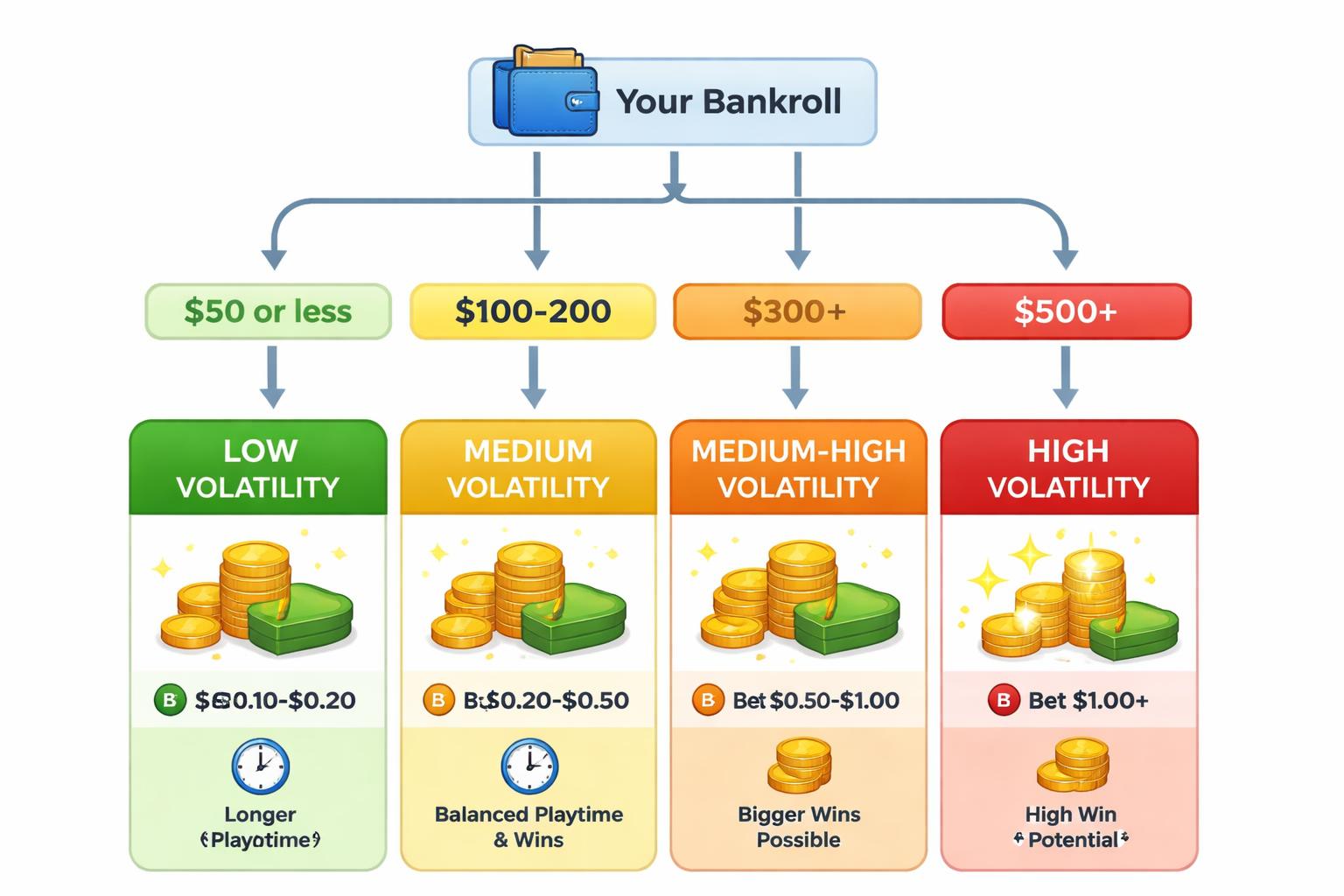
Use this flowchart to pick the right volatility:
Start Here: How much are you depositing?
→ $50 or less?
- Play LOW or LOW-MEDIUM volatility only
- Bet $0.25-0.50 per spin maximum
- Your goal: extend playtime, have fun
→ $100-200?
- MEDIUM volatility is your sweet spot
- Bet $0.50-1.00 per spin
- Your goal: balanced entertainment with occasional excitement
→ $300+?
- You can handle MEDIUM-HIGH volatility
- Bet $0.75-1.50 per spin
- Your goal: chase bigger wins with acceptable risk
→ $500+ and feeling lucky?
- HIGH volatility is on the table (but still risky)
- Bet $1-2 per spin
- Your goal: go big or go home
Time-Based Decision:
Planning to play for 2+ hours? Low volatility keeps you alive and entertained. Quick 30-minute session? Medium volatility delivers action without requiring a massive bankroll. Chasing one big hit? That’s when high volatility makes sense, but expect to lose fast. First time at a casino? Always start with medium volatility to test the waters.
RTP vs. Volatility: The Confusion That Costs You Money
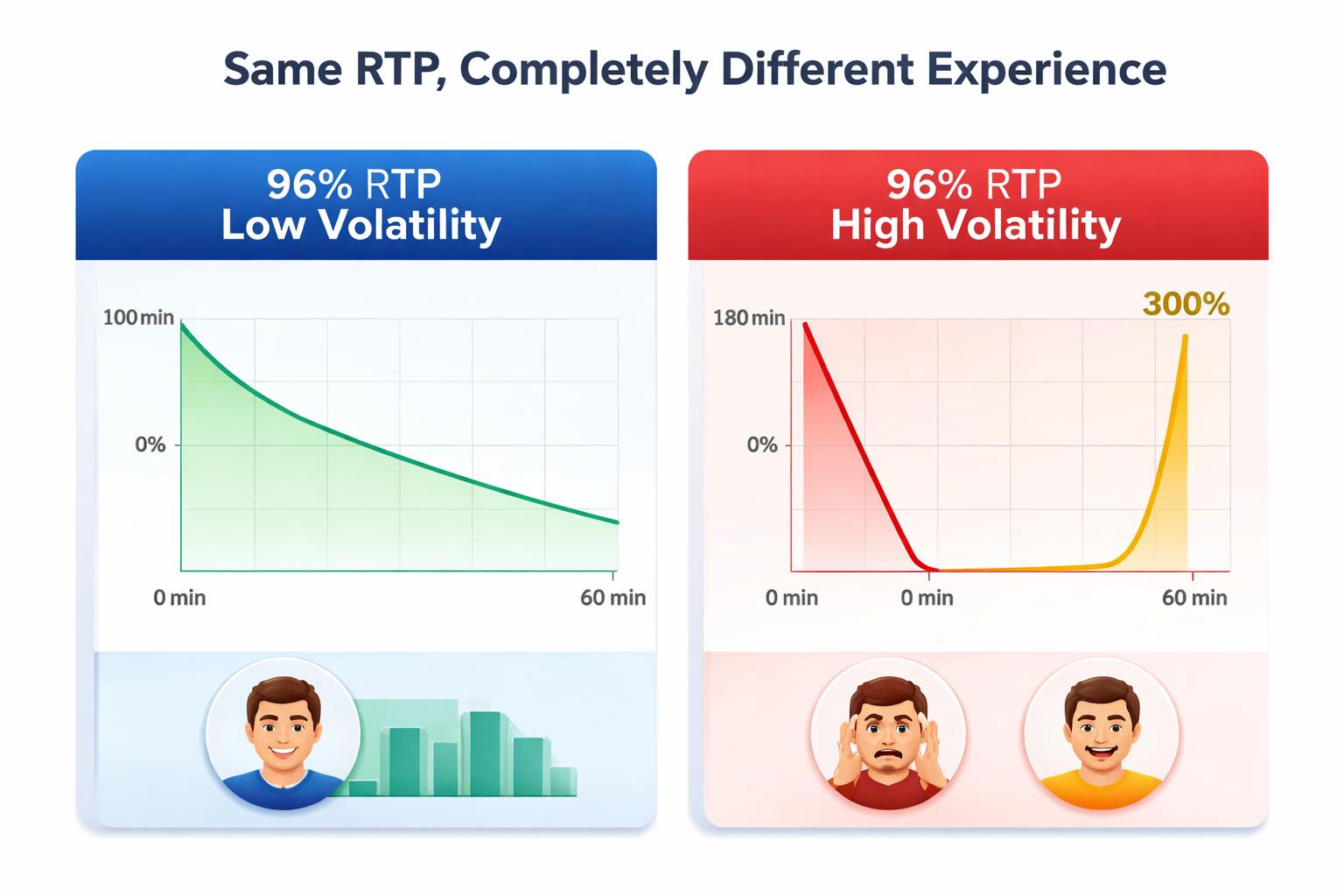
Here’s what trips everyone up: RTP and volatility are completely different things, yet players constantly confuse them.
RTP (Return to Player) is the long-term theoretical payback percentage. A 96% RTP means over millions of spins, the game returns $96 per $100 wagered. This happens over the LONG term—not your individual session, not even your month of playing. Every slot has RTP published somewhere, usually ranging from 94-97%.
Volatility describes how those returns are distributed. Low volatility means returns come in small, frequent chunks. High volatility means returns come in rare, massive chunks. Same RTP, completely different experience.
Imagine two games, both with identical 96% RTP. Game A has low volatility. You deposit $100, play for 60 minutes, have frequent 2x-5x wins keeping you engaged, and cash out at $94. You had fun, felt entertained, experienced minimal stress, and would probably play again.
Game B has high volatility with that same 96% RTP. You deposit $100, play for 18 minutes, get almost nothing, bust out at $0, and leave frustrated and angry. Or alternatively, in a different session with the same game, you deposit $100, play for 15 minutes, hit a bonus round for 300x, cash out at $300, and feel ecstatic while telling everyone about your “lucky” casino.
Same 96% RTP. Wildly different experiences. That’s volatility in action, and it explains why two players can have completely opposite opinions about the exact same casino.
For casual players, this means you should choose low volatility even if RTP is 94%. You’ll genuinely have more fun and play longer than a 97% RTP high volatility game that busts you in 10 minutes. For bonus hunters, low volatility helps you meet wagering requirements without going broke—a 30x bonus wagering requirement is infinitely easier on Starburst than Money Train 2. And for jackpot chasers, high volatility with competitive RTP (96% or higher) gives you the best shot at life-changing wins, just expect many, many losing sessions along the way.
What Casinos Don’t Tell You
1. Lobby Positioning Is Strategic
- Top of the lobby: Usually medium or low-medium volatility games. Casinos want new players to have good first experiences.
- “Hot” or “Popular” sections: Medium volatility games that balance player satisfaction with profit.
- “Max Win” or “Big Win Potential” sections: High volatility games used as marketing hooks.
2. Bonus Terms Match Volatility
Ever notice some bonuses exclude certain games? That’s volatility management.
- Welcome bonuses: Often restrict high volatility slots because players could hit one massive win and cash out immediately.
- Free spins bonuses: Usually given on low-medium volatility games to ensure players have fun without huge operator risk.
- VIP cashback: Often better on high volatility games because casinos know you’ll lose more frequently.
3. The “Hot” and “Cold” Myth
Casinos show “hot” and “cold” games. Players think these games are “due to hit.” This is pure psychology, not mathematics.
Each spin is independent. RNG (Random Number Generator) doesn’t remember previous results. A game that hasn’t paid in 200 spins isn’t “due”—it’s just high volatility doing what high volatility does.
4. Volatility Varies By Market
The SAME game can have different volatility settings:
- European version: Higher volatility, lower RTP (94-95%)
- US version: Medium volatility, higher RTP (96%)
- Asian version: Higher volatility, maximum win potential emphasized
Operators choose settings based on player preferences. Asian markets historically prefer high volatility with big max wins. European casual players often prefer more frequent, smaller wins.
For Casino Operators: The Strategic Playbook
When starting an online casino, volatility isn’t just a feature—it’s your primary profitability lever.
The 40-40-20 Portfolio Strategy
| Category | Allocation | Primary Purpose | Ideal Placement | Retention & Performance |
| Low to Low-Medium Volatility | 40% | Volume drivers, retention, and wagering completion. | Top lobby, welcome bonuses, mobile featured. | 35-45% Day 7 retention. |
| Medium Volatility | 40% | Core profit centers and broad player appeal. | Main categories, tournaments, promotions. | 28-35% Day 7 retention; highest GGR. |
| Medium-High to High Volatility | 20% | Marketing hooks, viral moments, and streamer bait. | “Max Win” sections, new releases. | 18-25% Day 7 retention; creates brand buzz. |
-
The 40% (Low): Keeps players in the game longer. By providing frequent, smaller wins, you reduce “churn” early in the player lifecycle.
-
The 40% (Medium): This is the engine room. These games hit the sweet spot between entertainment value and mathematical house edge.
-
The 20% (High): Even though retention is lower, these titles provide the “big win” screenshots and videos that act as free organic marketing on social media.
When Custom Slot Development Makes Sense
Off-the-shelf games work for most operators, but custom volatility engineering delivers competitive advantages—similar to how custom slots become player favorites.
Scenario 1: You Have Unique Player Data
The Problem: Your analytics show players want more frequent wins than industry average, but still want 5,000x max win potential. Standard “medium volatility” doesn’t fit.
The Solution: Custom math model with:
- 32% hit frequency (vs. standard 25%)
- Smaller typical wins (2x-15x vs. 2x-20x)
- Same 5,000x max win through bonus engineering
- Result: 41% Day 7 retention vs. 27% with standard games
Real Example: European mobile operator serving casual players aged 35-55 increased retention by 52% with custom low-medium volatility games.
Investment: $80,000-150,000 for full custom development
ROI Calculation: If you’re acquiring 1,000 players monthly at $300 each, that 14-point retention improvement = $420,000 additional lifetime value annually. The custom game pays for itself in under 3 months.
Scenario 2: Regulatory Compliance
Some jurisdictions impose unique constraints on maximum wins, RTP floors, or hit frequencies that standard games don’t accommodate. Custom development ensures compliance while maintaining player appeal.
Scenario 3: Proprietary Differentiation
Exclusive games optimized for YOUR player base cannot be offered by competitors. This improves player stickiness and reduces churn. When every casino has the same NetEnt and Pragmatic Play games, having exclusive titles that perform better for your specific audience becomes incredibly valuable.
When building a complete iGaming brand, having games that work across your target markets without compromise becomes a significant competitive advantage.
Volatility isn’t just a technical detail—it’s a strategic lever directly impacting player acquisition costs, retention rates, lifetime value, and regulatory compliance. Whether you’re exploring how to start a sportsbook or building a social casino, understanding volatility helps you avoid the common mistakes new casino operators make.
Get it right and you’ll build a sustainable, profitable business. Get it wrong and you’ll watch players walk away frustrated while your marketing budget evaporates.